SaaS Pricing Strategy
SaaS Pricing Strategy That Drives Growth, Not Discounts
B2B SaaS companies set pricing once and revisit it when deals start stalling. By then, the damage is done.
The Problem
Pricing set by intuition, defended by habit
The founder picked a price point at launch based on what competitors charged. Three years later, that number is still on the pricing page. Discounting has become the default sales motion. Packaging doesn't reflect how customers actually consume value. And the pricing page itself is undercutting category positioning by signaling "cheap" when the product delivers enterprise-grade outcomes.
Pricing decisions made in isolation from positioning and ICP compound in the wrong direction. Every discount trains the market. Every misaligned package leaves money on the table. Every pricing page that doesn't connect to your value story makes the sales team work harder.
What It Costs
Revenue model problems that show up everywhere
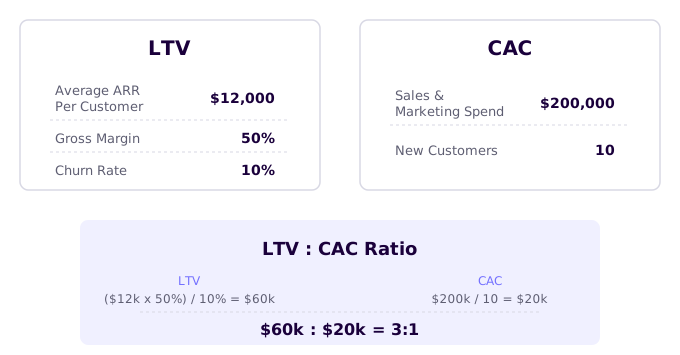
Deals lost on price perception
Not because the product is too expensive. Because the pricing page doesn't connect the price to the value the buyer receives. The number is there. The story isn't.
CAC rising without a pricing fix
When pricing doesn't reflect value consumption, you compensate with more marketing, more sales effort, more discounting. CAC rises because the revenue model has a structural problem, not an acquisition problem.
Revenue model that can't scale
Flat-rate pricing on a product with variable value delivery. Per-seat pricing on a platform where value compounds with usage, not headcount. The model worked at $500K ARR. It breaks at $5M.
Discounting as default motion
Reps discount because they don't have the positioning to hold price. The pricing page doesn't arm them. The packaging doesn't match the buyer's use case. So they cut the number and move on.
What We Build
Pricing connected to positioning, not pulled from a spreadsheet
Outcome Marketing practitioners build SaaS pricing strategies from your market bets outward. Through the Bets-to-Story system, pricing decisions flow from bet definitions: which ICPs you're targeting, what value they consume, and how your positioning justifies the number. Pricing is a marketing decision before it's a finance one.
The connection to product marketing is direct. Packaging reflects how customers consume value. Positioning justifies the price point. The pricing page becomes a conversion tool, not a negotiation starting point.
ICP-grounded pricing model
Pricing aligned to how your specific ICPs buy and consume value. Not a benchmark study. A model grounded in your market bets and buyer behavior.
Packaging tied to value consumption
Tiers and bundles that reflect how customers actually use the product. Good-better-best only works when the "better" maps to a real expansion trigger.
Positioning-connected pricing
A pricing page where the number makes sense because the story around it is clear. Sales holds price when the positioning does the work.
Survey-based validation
Pricing decisions tested with real buyers before they go live. Willingness-to-pay research structured through the SaaS Pricing Survey Template. Data, not guesswork.
Free Template
SaaS Pricing Survey Template
Test pricing with real buyers before you commit. Includes willingness-to-pay questions, packaging validation, and analysis framework. Non-gated.
Download Pricing Survey TemplateProof
Complexity made navigable
"Every few years I read a book that completely shifts my perspective on a topic. Outcome Marketing was one of those books. This book takes an incredibly complex topic and distills it down into continually more digestible bits such that you understand the topic at every altitude. A must-read for business leaders or anyone looking to become one."Adam, Business Leader
Frequently asked questions
-
There is no universally best B2B SaaS pricing model. Per-seat works when value scales with users. Usage-based works when value scales with consumption. Flat-rate works for simple products with predictable use patterns. The right model depends on how your specific ICP consumes value, not on what competitors charge. The most common mistake is choosing a model based on what's easy to implement rather than what reflects how buyers get value from the product. A pricing model misaligned to value consumption creates friction at expansion, makes discounting the default sales motion, and caps revenue growth.
-
Three signals. First, reps discount on most deals and managers approve it. That means the pricing page isn't doing the positioning work. Second, expansion revenue is flat even as usage grows. That means the packaging doesn't capture value as the customer gets more from the product. Third, deals stall or die at the pricing conversation, not the demo. That means the number doesn't connect to the value story the buyer heard. Any one of these is a pricing problem. All three together means the pricing model needs a structural rethink, not a rate adjustment.
-
Pricing sets the unit economics that demand generation operates within. When pricing is right, CAC targets are achievable because the revenue per customer justifies the acquisition cost. When pricing is wrong, demand gen looks like it's failing because the math doesn't work regardless of channel performance. Pricing also affects positioning: a premium product priced like a commodity sends a signal that demand gen has to overcome. Getting pricing right before scaling demand gen spend means every campaign dollar works harder because the conversion math makes sense.
Related services
Fractional CMO
The leadership layer that connects pricing strategy to your broader go-to-market system and Bets-to-Story methodology.
Fractional Product Marketing
Pricing is core product marketing territory. Positioning, packaging, and the pricing page work as a system.
Demand Generation
Pricing sets the unit economics. Demand gen operates within them. Get pricing right first and every channel works harder.
Price for how buyers get value. Not for what competitors charge.
Find a practitioner who builds pricing strategies grounded in your ICP, not a benchmark study.
Browse Marketplace