Fractional Product Marketing
Product Marketing Consultant Who Bridges Product and Market
When positioning lives in the product team's heads and enablement is a slide deck nobody updates, the bridge between product and market is broken.
The Problem
Product launches without a market-ready narrative
Product marketing owns the bridge between what you build and what the market buys. Without it, demand gen runs on weak messaging, sales pitches features instead of outcomes, and launches land with a press release that nobody reads. Fractional product marketing gives B2B SaaS companies that bridge without the overhead of a full-time hire.
The gap shows up everywhere. Positioning is tribal knowledge that lives in the founder's head. Sales decks are built by reps who copy the last version. Competitive intelligence is a spreadsheet from last year. A product marketing consultant connects these pieces into a system that sales, marketing, and product can all use.
What It Costs
The product ships. The market doesn't notice.
Launches land quietly
New features and products ship without a go-to-market narrative. The announcement goes out. Prospects don't engage. The team moves on to the next release, and the pattern repeats.
Win rates declining
Sales pitches features because there's no positioning to anchor on. Buyers hear specs, not outcomes. Competitors who tell a better story win deals against a stronger product.
Sales cycles lengthening
Without enablement materials that match the buyer's journey, reps build their own decks and battle cards. Every deal becomes a custom pitch. The cycle stretches because the buyer has to do the positioning work themselves.
Roadmap disconnected from market value
Product builds what customers ask for. But without market-facing translation, the roadmap doesn't connect to revenue. Features ship that solve real problems but never reach the buyers who have them.
What We Build
Product marketing grounded in your bets
Outcome Marketing practitioners don't start with launch calendars. They start with Bets-to-Story, the methodology that turns your strategic bets into defensible positioning. Product marketing is built on that foundation. Every deliverable connects back to what the company decided to bet on.
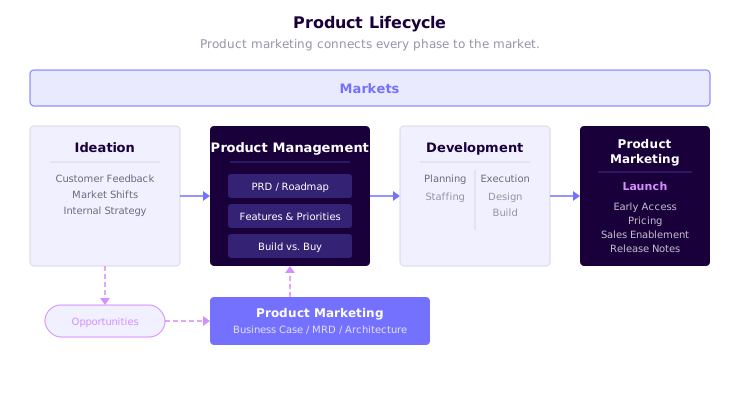
Positioning from Bets-to-Story
Market positioning starts upstream with your bets, not downstream with competitor feature matrices. The result is a positioning foundation that sales, marketing, and product all reference.
Launch planning and execution
From internal alignment to market narrative to channel activation. The Setup-to-Execute arc ensures launches have a story the market cares about, not just a feature list.
Sales enablement
Battle cards, pitch decks, objection handling, and buyer personas built from positioning, not from the last deal a rep closed. Connects to the broader sales playbook system.
Competitive intelligence
Ongoing market and competitor analysis that feeds positioning updates and sales enablement. Structured insight, not a one-time spreadsheet. Pairs with Campaigns research for buyer-validated intelligence.
Free Template
Product Launch Checklist
A structured checklist covering positioning, internal alignment, channel activation, and post-launch measurement. Built from the same methodology Outcome Marketing practitioners use with clients.
Download Launch Checklist →Proof
A system for modern B2B SaaS marketing
"Outcome Marketing is the most comprehensive view of how to run and organize a modern B2B SaaS marketing team."Rick Collins, Vice President, Demand Generation, ConnectWise
The Practitioners
Product marketing practitioners in the network
Practitioners who own positioning, competitive intelligence, and launch strategy — the messaging muscle that makes everything else work.
Frequently asked questions
-
A product marketing consultant owns the bridge between what your company builds and what the market buys. That includes positioning, go-to-market launch planning, sales enablement, and competitive intelligence. In B2B SaaS, product marketing ensures that product capabilities translate into buyer-relevant narratives, that sales has the materials to run those narratives consistently, and that launches reach the right audience with the right message.
-
The need typically surfaces when launches land quietly, sales pitches features instead of outcomes, or competitive positioning is tribal knowledge that lives in the founder's head. Companies at Series A through growth stage often have the product but not the go-to-market narrative. A fractional product marketing engagement fills that gap without the cost and commitment of a full-time VP-level hire.
-
Product marketing defines what to say and to whom. Demand generation distributes that message through channels. Product marketing sets the positioning, crafts the narrative, and builds the enablement materials. Demand gen takes that foundation and runs campaigns, content programs, and paid media to generate pipeline. One sets the message. The other amplifies it. Companies that run demand gen without product marketing in place tend to cycle through messaging every quarter because there's no positioning foundation to build on.
Related services
Fractional CMO
The strategic leadership layer that connects product marketing to your broader go-to-market system.
Demand Generation
The channel engine that amplifies the positioning and messaging product marketing sets.
Sales Playbook
The enablement system where product marketing deliverables become repeatable sales conversations.
Bridge the gap between product and market.
Find a practitioner who builds product marketing systems on positioning, not assumptions.
Browse Marketplace