GTM Blueprint
GTM Blueprint From Your Strategy
Brand positioning, messaging architecture, and brand style guide — AI-accelerated, built on the Outcome Marketing methodology.
What Changes
The document that governs how your company goes to market
The GTM Blueprint isn't a PDF that lives in a shared drive. It's the operating document that changes how the company works. Your team knows what to say. Your agency doesn't need onboarding. Your AI tools pull from the same source of truth. Your brand holds together as you scale.
This is the Setup phase of Setup, Execute, Scale — the artifact that makes everything downstream faster and more consistent.
Brand positioning
Who you are, what you stand for, and how you're different from every competitor in your category. Defined once, referenced everywhere.
Messaging architecture
Conversations to Own, pain-point framing, and proof points mapped to each audience segment. Your sales team, content creators, and AI tools all work from the same language.
Competitive landscape
Where you sit relative to your competitors and which conversations nobody owns yet. The white space your go-to-market strategy should target.
Style guide
Visual direction, voice, tone, and usage rules. Detailed enough that any designer, writer, or AI content tool can produce on-brand work without a briefing.
Why This Is Different
Built to be used — by your team, your agency, and your AI tools
A traditional brand engagement takes 8-12 weeks and produces a PDF. The Outcome Marketing GTM Blueprint is built as a living HTML document — structured, searchable, and machine-readable by design. When your team needs to write a landing page, they reference it directly. When an AI content tool needs brand context, it reads from the same source.
That's a feature of the methodology, not the technology. AI accelerates the document generation. The practitioner ensures the strategy is right. The result is delivered in 1-2 weeks instead of months, and it's designed to be used daily, not filed away.
How It Works
Three steps. One to two weeks.
1. Bets Workshop
A 90-minute practitioner-led session where your exec team aligns on the bets that matter: which products, which markets, which go-to-market motions. The strategic foundation is built in the room, not inferred from a questionnaire. Competitive data, customer language, and visual direction feed in alongside.
2. AI-accelerated generation
Workshop outputs, interview language, and competitive data become the GTM Blueprint. Positioning, messaging architecture, Conversations to Own, competitive landscape, and style guide — generated from real inputs, structured as a living document.
3. Practitioner review
The practitioner reviews every section, refines the strategy, and ensures the document is accurate, actionable, and ready to govern your go-to-market. You review and approve before it's final.
See It
This is what a GTM Blueprint looks like
The site you're reading was built from a GTM Blueprint. The positioning, messaging, Conversations to Own, competitive landscape, and style guide that govern this website all live in one document — and we've made it available for you to review.
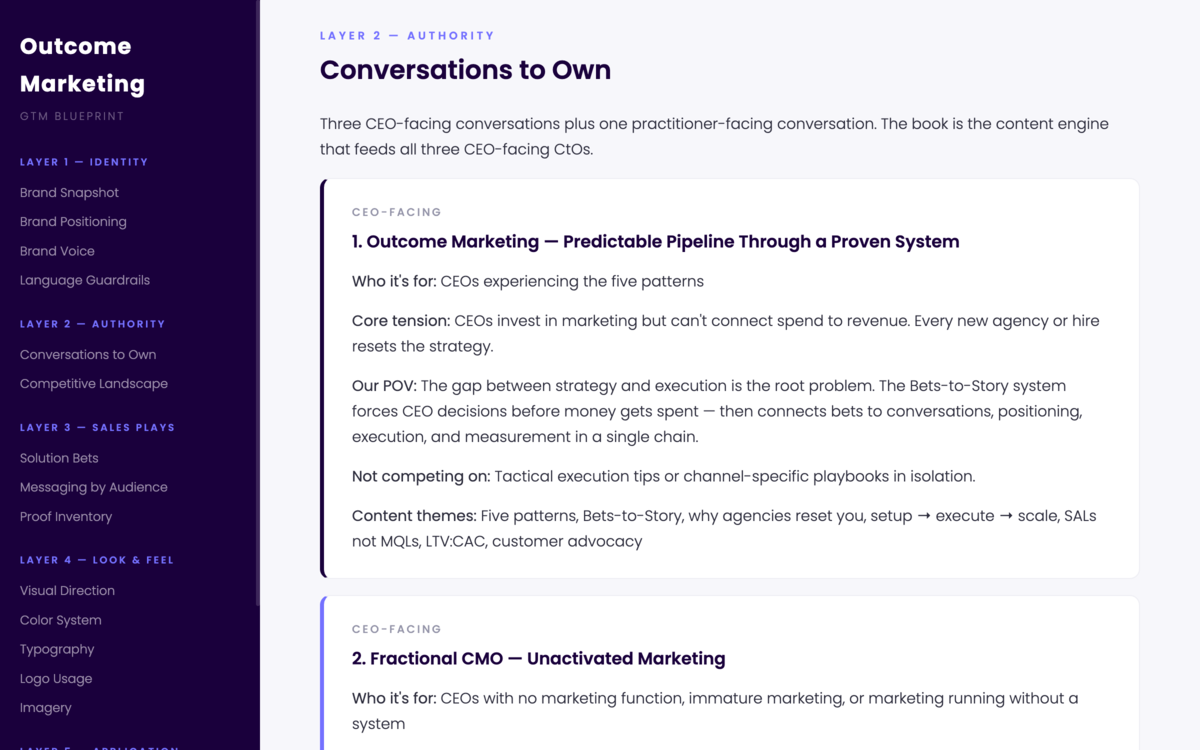
We practice what we preach. The Outcome Marketing GTM Blueprint is the same deliverable our practitioners build for clients — brand positioning, messaging architecture, competitive landscape, and style guide in one living document. View the full GTM Blueprint.
Once the Blueprint is built, the website follows — designed and developed directly from the same document.
Frequently asked questions
-
A brand book is the philosophy — why every B2B company needs defined positioning and messaging, and what happens without it. The GTM Blueprint is the deliverable — the actual document built from your bets (which products, which markets, which go-to-market motions), your competitive landscape, real customer language, and your team's alignment on positioning. The brand book page explains why it matters. This page describes what you get and how it's built.
-
Three differences. First, timeline: a brand agency engagement typically runs 8-12 weeks. The GTM Blueprint is delivered in 1-2 weeks. Second, format: agencies produce PDFs. The GTM Blueprint is a living HTML document that your team and AI tools can reference directly. Third, depth: agencies focus on visual identity and messaging. The GTM Blueprint includes competitive landscape analysis, Conversations to Own, and go-to-market strategy — the strategic layer that connects brand to pipeline.
-
Yes. The GTM Blueprint is designed to be the single source of truth for any tool or team that touches your brand. Designers reference the visual direction. Writers reference the voice and messaging. AI content tools reference the positioning and proof points. Agencies reference the competitive landscape and Conversations to Own. Because it's structured as an HTML document rather than a static PDF, the content is accessible to both human teams and AI systems without reformatting.
-
A brand style guide defines how your company presents itself — visually, verbally, and strategically. At minimum, it should include your brand positioning, visual identity (colors, typography, logo usage), voice and tone guidelines, and messaging framework. The OM GTM Blueprint goes further: it includes your competitive landscape, Conversations to Own (the market narratives your company should lead), proof points mapped to audience segments, and language guardrails that keep your brand consistent across every channel and team.
-
Yes. The Outcome Marketing GTM Blueprint is the same deliverable our practitioners build for clients. It covers brand positioning, messaging architecture, Conversations to Own, competitive landscape, visual direction, and voice guidelines. We use it to govern this website, our content, and our AI tools. Review it to see exactly what a GTM Blueprint contains and how it's structured.
-
The GTM Blueprint is the upstream input for everything else. Your website is built from the positioning and visual direction in the Blueprint. Your content strategy is built from the Conversations to Own and messaging architecture. Your demand generation programs are built from the ICP definitions and competitive landscape. Without the Blueprint, each of these efforts starts from scratch and drifts over time. With it, they compound — every piece of content, every page, every campaign reinforces the same positioning.
The positioning comes first. Everything else follows.
Brand positioning, messaging architecture, and style guide. Delivered in 1-2 weeks, built to last.
Book Bets Workshop