Brand Book for B2B Companies
A Brand Book for You and Your AI
Your positioning, messaging, and visual identity in one living document — built for your team and your AI tools.
The Problem
The brand guide nobody opens
B2B companies have been through the process at least once. A branding agency runs a series of workshops. The output is a PDF — 40 pages of logo usage rules, color swatches, and aspirational messaging. It gets shared in Slack. A few people skim it. Then it sits in a folder nobody visits.
The problem isn't the workshop. The problem is the output. A static PDF can't enforce consistency across campaigns, sales decks, website pages, and AI-generated content. It's a reference document that nobody references. And when the next agency or hire arrives, they start from scratch — because the PDF doesn't connect to how the company actually goes to market.

"Outcome Marketing is a practical handbook that every marketing leader should have, whether you're new to the field or aiming to elevate your skills. The clear examples and exercises make it an easy-to-follow guide, filled with insights from experienced marketers who've been through it all."Jessica Johnston, VP Marketing Education, Advanced
The Reframe
What a brand book should be
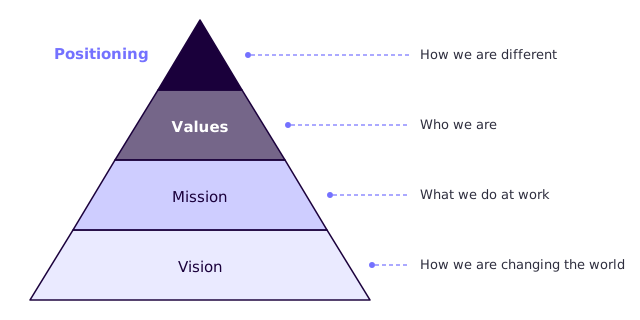
A brand book isn't a style guide. It's the strategic foundation that everything else builds from — your website, your content, your campaigns, your sales materials, and the AI tools that generate them.
It starts with your market bets. Through the Bets-to-Story system, the CEO and executive team align on where the company is investing, which markets it's pursuing, and what it's saying no to. Those bets become the inputs for positioning, messaging, voice, and visual identity — all captured in one structured, living document.
When the brand book is machine-readable, AI generates on-brand content without manual enforcement. Every page, every email, every campaign connects back to the same strategic foundation. The brand compounds instead of drifting.
Team Alignment
Everyone executes from the same strategic foundation. No more re-briefing every new hire or agency.
AI-Ready Content
Your AI tools generate on-brand copy because the brand book is structured for them to read.
Website in Weeks
Strategy and website as a single deliverable. Not a six-month branding project followed by a six-month web build.
Why It's Different
Same inputs. Fundamentally different output.
Traditional
The brand book you've gotten before
- —Output is a static PDF nobody references after week one
- —Website is a separate project, separate vendor, separate timeline
- —AI tools can't read it. Every asset requires manual interpretation
- —The brand drifts from day one
AI-Accelerated
Practitioner-orchestrated. Machine-readable.
- ✓Output is a living HTML document that AI tools read directly
- ✓Website builds directly from the brand book. One deliverable.
- ✓Updates flow through. New bet, new competitor, the document evolves.
- ✓The brand compounds instead of drifting
It starts with a 90-minute workshop where your stakeholders align on the bets that drive everything downstream.
Book Bets WorkshopWe Practice What We Preach
Built the same way we build yours
The website you're reading right now was built from a brand book. Outcome Marketing's own brand book — we call it a GTM Blueprint — defines every color, heading, word choice, and CTA on this site. It's not a PDF. It's a living HTML document that AI tools read directly to generate on-brand content and code.
View OM GTM Blueprint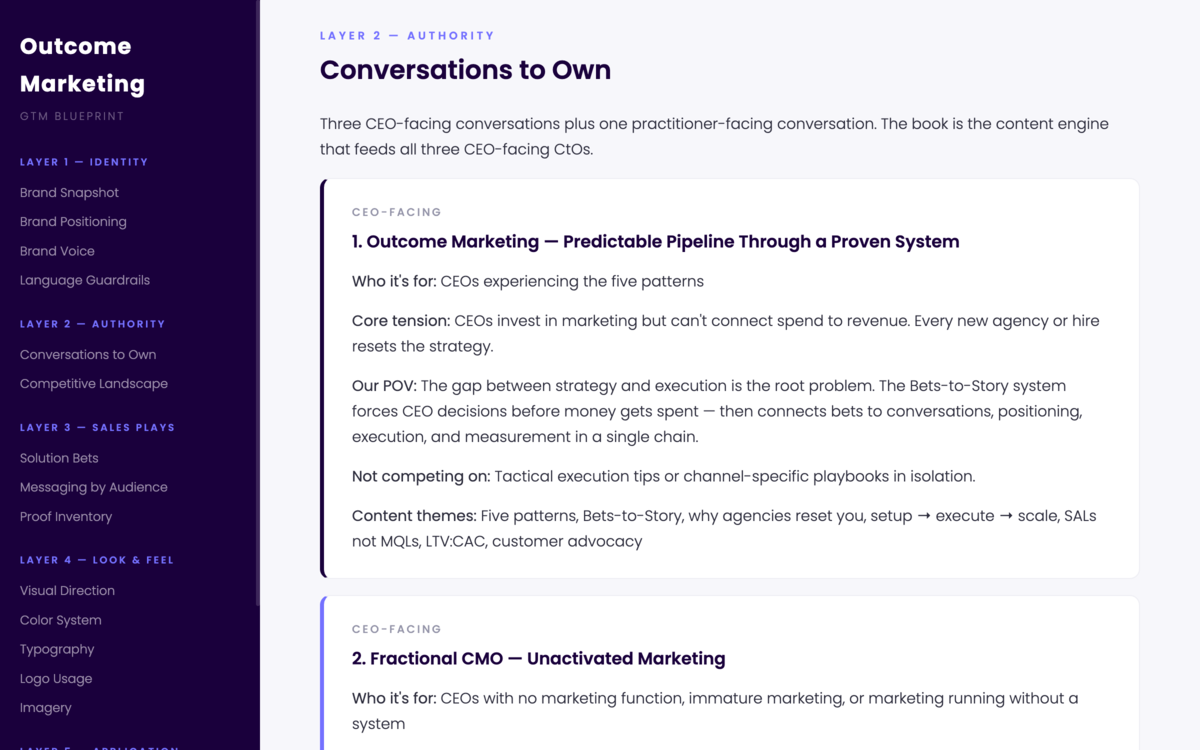

"As a startup with limited resources, we relied on Outcome Marketing to guide our go-to-market and digital strategy so we could quickly exceed $1M in revenue."May Huang, Founder & CEO, DodiHome
The Foundation
What's inside the brand book
Four elements. Each one connects to the next. Together they form the strategic foundation that your website, content, campaigns, and AI tools build from.
1. Market Bets
Where the company is investing, which products land new logos, which markets you're pursuing, and what you're saying no to. Every campaign and hire traces back to these decisions.
2. Messaging Architecture
Value propositions per persona, proof points mapped to buyer objections, and the Conversations to Own that position the company. Your sales team says the same thing on every call.
3. Brand Voice
Tone, vocabulary, writing rules, and content patterns. A new hire or an AI system produces on-brand copy without a style call.
4. Visual Identity
Color system, typography, spacing, imagery direction, and component patterns. Your website, decks, and campaigns look like they came from the same company.
The Practitioners
Brand-book specialists in the network
Practitioners and agencies who build brand books that connect strategy to execution — positioning, voice, and visual system as one system, not three disconnected documents.

Patti Sanchez
Strategic Communications Consultant
PattiSan Communication
Strategic Communications Consultant with 30+ years experience
View Profile
Oh Wow Creative
Creative & Production Agency
Brand photography, video production, and event streaming for B2B technology and enterprise clients
View Profile
Rich M. Smith
Fractional CGO
Rich M. Smith Growth Studio
Removes the smoke and mirrors from B2B growth strategy with behavioral science and buyer psychology
View Profile
Kaspo
Branded Merchandise & Event Marketing Agency
Branded merchandise and event marketing tied to campaign objectives, not swag for the sake of swag
View ProfileFrequently asked questions
-
A brand book is the strategic document that captures your company's positioning, messaging, voice, and visual identity in one place. For B2B technology and SaaS companies, it defines your market bets, value propositions per persona, proof points, tone of voice, color system, typography, and component patterns. When structured correctly, a brand book serves as the single source of truth for your website, content, campaigns, sales materials, and AI-generated assets. The difference between a brand book that works and one that doesn't is whether it's connected to your go-to-market strategy or just a collection of logo usage rules.
-
A brand style guide typically focuses on visual identity — logos, colors, typography, imagery rules. A brand book, as OM defines it, goes deeper: it includes the strategic layer (market bets, positioning, Conversations to Own) alongside the visual and voice guidelines. The strategic layer is what makes the difference. A brand style guide tells designers which shade of blue to use. A brand book tells your entire organization — and your AI tools — what to say, why, and to whom.
-
Usually because it's a static PDF that lives in a folder nobody visits. It was produced at the end of a branding engagement, shared once, and never integrated into how the team actually works. The fix isn't a better PDF. It's a living document — ideally HTML, not a file — that connects directly to your go-to-market operations. When the brand book is the input your AI tools read, the template your website builds from, and the reference your team checks before writing anything, it stays current because it's in use every day.
-
With AI-Accelerated delivery, clients can expect brand and style guide completion in 1-2 weeks from the first workshop session. A traditional branding engagement takes 3-6 months for comparable depth. The difference is a fractional CMO who manages the process using structured methodology, with AI that compresses the timeline and improves the result — more consistent, more thorough, machine-readable from day one.
-
Yes. A website redesign without a brand book is a visual refresh, not a strategic one. The brand book defines the messaging architecture, proof points, and voice guidelines that every page builds from. Without it, designers make aesthetic choices disconnected from your go-to-market bets, and copywriters default to generic language. The brand book is the input. The website is the output.
-
Four layers. Market bets: the 2-3 categories you're choosing to win and the positioning that backs each one. Messaging architecture: value propositions mapped to each buyer persona, with proof points attached. Brand voice: tone, vocabulary, sentence structure, and rules specific enough for a person or an AI to follow. Visual identity: color system, typography, component patterns, and imagery direction. Most brand books stop at the visual layer. A B2B brand book that actually gets used starts at the strategy layer and works down.
-
AI can accelerate a brand book. It cannot replace the strategic decisions that make one useful. A fractional CMO defines the market bets, validates positioning against competitive reality, and structures the messaging architecture. AI then compresses the production timeline — generating voice examples, drafting component patterns, stress-testing consistency across personas — in days rather than months. The result is a brand book that is both strategically sound and machine-readable from day one.
Start with your bets. Everything else follows.
The conversation starts with a 30-minute discovery call. No pitch. Just diagnosis.