Voice of Customer
Voice of Customer Research to Validate Strategy
One practitioner. Win-loss interviews, battle cards, case studies, and GTM Blueprint updates — every month. The customer intelligence function your company doesn't have.
The Problem
Customer intelligence is fragmented across your company
One team runs NPS. Another collects case studies. Sales logs win-loss reasons in the CRM. Customer success handles QBRs. Product reads support tickets. Nobody synthesizes the signal. The CEO gets dashboards, not ground truth.
The result: positioning drifts from reality. Messaging reflects what the company believes, not what customers experience. Competitors show up in deals and nobody connects the pattern. Happy customers who would refer you are never asked. This is one of the Five Patterns — customer neglect — and it compounds quietly until win rates start to drop.
What You Get
One practitioner. One system. Continuous signal.
Monthly: win-loss interviews
3-5 practitioner-led calls per month. The same practitioner who built your GTM Blueprint — they already know your bets, your positioning, and your competitive landscape. AI-accelerated synthesis extracts patterns and exact customer language across every interview.
Monthly: battle cards
3-5 competitive battle cards, created from real buyer conversations and maintained as new data comes in. What reps actually hear in deals, not what marketing assumes competitors are saying.
Quarterly: case studies and proof assets
2-3 case studies per quarter with derivative assets — website quotes, social media posts, and sales success stories. Win interviews are a direct pipeline to proof your marketing and sales teams can use across the customer journey.
Quarterly: strategy validation
Executive readout on what customers and lost prospects are saying. GTM Blueprint updates, website copy refinements, and sign-off on changes. The insights feed back into your positioning so it stays grounded in reality, not assumptions.
Why Ongoing
An intelligence function, not a project
Companies that run win-loss programs for two or more years report an 84% improvement in win rates. The data compounds. Each interview makes the next one more valuable because patterns that are noise at 3 interviews become signal at 10. A quarterly program is fighting the last war. A monthly cadence keeps your positioning, your battle cards, and your proof assets current.
Download
VoC Win-Loss Interview Guide
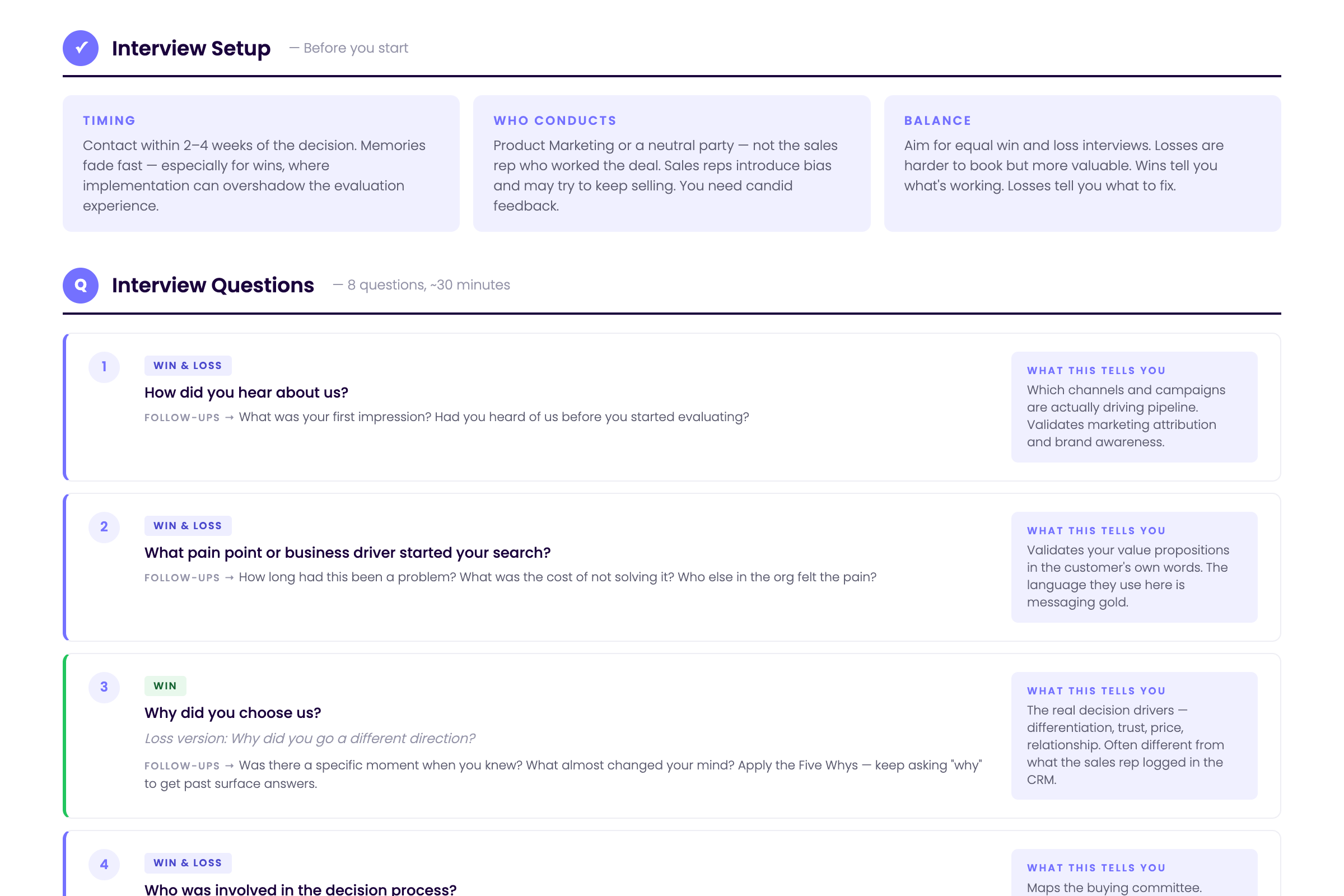
If you want to start running win-loss interviews before engaging a practitioner, this guide gives you the framework. A structured approach to conducting win-loss interviews that validate competitive positioning, refine your story, and turn customer feedback into actionable GTM insights. Includes 8 questions with follow-ups, interview techniques, and LLM prompts for automated transcript analysis.
Built on the Outcome Marketing methodology. Non-gated — download it and use it.
Patterns We See
One conversation can change everything
These are real examples. No company names — the pattern is the point. Each one started with a single conversation that changed something material.
Customers rejected the product. The company listened.
A SaaS company brought a new platform to their customer advisory board. The feedback was direct: the product gave them nothing new. But the customers endorsed the vision — they wanted innovation, not migration. The company went back, built a category-first feature, and launched ahead of their largest competitor. Four years later, it's their highest-volume product. Without that conversation, they would have shipped what their customers explicitly told them not to.
Detractors became advocates. With a phone call.
A B2B company called their NPS detractors — the 0s and 1s. Not a follow-up email. A call. Listening, solving the specific problem, watching the relationship turn around. Several became new opportunities. Advocates don't have to be happy customers. They can be people you rescued — the most frustrated customers are often the most passionate.
One call revealed a channel nobody knew existed.
A close-loss interview revealed the prospect found the company through a product listing site nobody on the team had heard of — with wrong information. The prospect's perception was biased before the first conversation ever happened. One call. One fix. Without that interview, the company would have kept losing deals to a channel that didn't exist in anyone's attribution model.
Frequently asked questions
-
A customer survey collects structured responses to predefined questions — useful for tracking satisfaction over time, but limited by what you thought to ask. Voice of customer research uses open-ended interviews where buyers describe their experience in their own language. The value is in the language itself: the exact words customers use to describe their problems, their decision criteria, and why they chose you (or didn't). That language becomes your messaging, your positioning, and your proof points. Surveys measure. VoC research discovers.
-
Patterns typically emerge after 5-8 interviews. For win-loss research specifically, aim for a balanced mix of wins and losses — losses are harder to book but often more valuable. A cadence of 3-5 calls per month builds a compounding dataset. AI synthesis makes each additional interview more useful than the last, because patterns that were noise at 3 interviews become signal at 10.
-
VoC research feeds directly into your GTM Blueprint. The language customers use to describe their problems becomes your pain framing. Their description of your value becomes proof points. Why they chose you (or didn't) becomes competitive positioning. Quarterly executive reviews ensure these insights update your Blueprint and website copy — keeping your go-to-market grounded in what buyers actually say, not what the company assumes.
-
Voice of customer analysis is the process of extracting patterns, themes, and actionable language from customer interviews and feedback. AI accelerates this by processing transcripts at volume — identifying recurring themes, extracting exact quotes, and surfacing patterns across interviews that a manual review would miss or take weeks to compile. The practitioner validates the output and ensures the synthesis reflects real strategic insight, not just word frequency. The result is a structured report your team can use immediately — not a transcript library.
-
Yes. If you have existing transcripts from sales calls, customer success conversations, support interactions, or previous research, those are valid inputs. The key is authentic customer voice — the actual language buyers use when they're making decisions or describing problems. Existing transcripts are often richer than purpose-built interviews because the buyer wasn't performing for a researcher. AI synthesis works across any transcript format.
Customer language refines the strategy. The loop starts again.
VoC research validates and sharpens your positioning. The insights feed back into your B2B SaaS marketing audit, your Blueprint, and your website.
Talk to Advisor