AI Displacement and Augmentation in Marketing
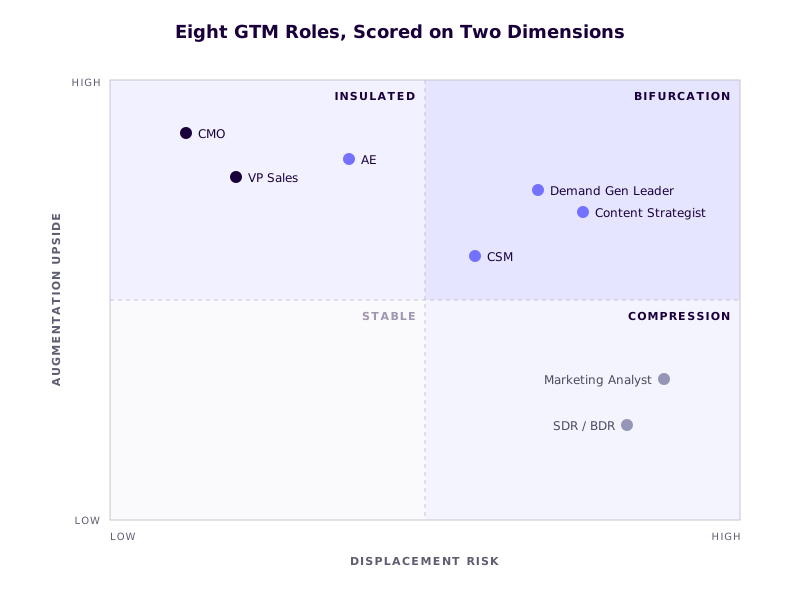
Eight GTM roles, scored on two dimensions. Where the AI dividend lands, and where the entry rung is compressing.
The marketing roles facing the most displacement pressure from AI are also the ones with the highest augmentation upside. That is not a contradiction. It is the central finding from a year of new labor-market data, and it is reshaping how B2B technology companies staff their go-to-market teams.
In 2026, marketing headcount growth in the United States dropped from 5.4% to 2.5% in a single year — the steepest deceleration on record. Companies with more than 10,000 employees actively shrank their marketing organizations by 0.8%. Generative AI use in marketing climbed from 15.1% to 22.4% of activities. AI-driven sales productivity gains rose from 8.6% to 14.1%. The two trends are connected, and they are accelerating.
This guide scores eight GTM roles on AI displacement risk and augmentation upside, draws on the 2026 CMO Survey, Anthropic's Economic Index and labor-market research, the Brynjolfsson "Canaries in the Coal Mine" study, and the counterview from Jevons-paradox economists who argue the AI dividend will expand the market rather than compress it.
Three economist camps, one consistent pattern
Three readings of AI's labor-market effect have emerged. They are usually presented as opposing views. Read together, they describe different layers of the same phenomenon.
The displacement view (Acemoglu, MIT). Generative AI is a "so-so technology" — it mimics tasks humans already perform without raising productivity meaningfully. The dominant economic effect is cost compression: companies save money on labor without producing more. Acemoglu estimates AI will lift total factor productivity by less than 0.66% over ten years. The displacement effect can exceed the productivity effect, and the result is fewer workers without proportionally more output.
The augmentation view (Brynjolfsson, Stanford). Controlled studies of AI in real workflows show consistent productivity gains, with the largest gains concentrated among lower-skilled workers. Brynjolfsson, Li, and Raymond's customer-support study found a 14% average improvement in tickets resolved per hour, and a 34% improvement for novice agents. The pattern is skill compression upward — AI raises the floor faster than it raises the ceiling, which makes senior judgment scarcer and more valuable per unit of output.
The expansion view (Slok, Apollo Global). Jevons paradox applies. When the cost of professional work falls, demand for that work expands faster than the labor saved. Apollo's chief economist points to the historical pattern: ATMs did not eliminate bank tellers in aggregate, accounting software did not eliminate the accounting profession, electronic trading expanded the financial-services workforce. Vanguard's December 2025 outlook found the 100 occupations most exposed to AI automation grew 1.7% in 2025 versus 0.8% for the rest of the labor market, with wages in exposed roles up 3.8% post-pandemic.
These readings are not mutually exclusive. The displacement effect lands hardest on routine tasks at the bottom of the skill curve. The augmentation effect lands hardest on workers with strong judgment and the discipline to direct AI output. The expansion effect lands at the industry level, as falling cost of work surfaces demand that was previously priced out. The question for any GTM leader is which layer their team is exposed to.
The framework
Each role is scored on two dimensions.
Displacement risk (X-axis). The proportion of the role's task volume that current AI systems can perform with limited human direction. Drawn from O*NET task structures, Eloundou et al. theoretical capability scores, and observed automation patterns in real deployments.
Augmentation upside (Y-axis). The proportion of the role's task volume where AI raises a skilled practitioner's output substantially. A high score means a senior practitioner with AI tools delivers what previously required a small team.
A role can score high on both. Those are the unstable positions in the matrix.
The supplemental table extends the framework to additional roles. The patterns hold.
| Role | Displacement risk | Augmentation upside | Quadrant |
|---|---|---|---|
| CMO | Low | Very high | Insulated |
| VP Sales | Low | High | Insulated |
| Brand Director | Low | High | Insulated |
| CS Leader | Low | High | Insulated |
| AE | Moderate | Very high | Augmented |
| Sales Engineer | Moderate | Very high | Augmented |
| Product Marketing Manager | Moderate | High | Augmented |
| Demand Gen Leader | High | High | Bifurcation |
| Content Strategist | High | High | Bifurcation |
| CSM | Moderate | High | Bifurcation |
| Field Marketer | Moderate | Moderate | Mixed |
| Marketing Operations | High | Moderate | Compression |
| Marketing Analyst | Very high | Moderate | Compression |
| SDR / BDR | Very high | Moderate | Compression |
Three patterns
The bifurcation zone
Demand Generation, Content Strategist, and CSM score high on both displacement and augmentation. This is the unstable quadrant. The commodity layer of each role — first-draft content, templated email sequences, basic campaign reporting, standard QBR prep — hollows out fast. A skilled content strategist directing AI output now publishes at the volume that previously required a team of five. A demand-gen operator with AI tooling replaces what used to be a three-person team. A CSM with AI-supported account-research and meeting-prep agents covers more accounts at the same depth.
The role does not disappear. It consolidates upward and becomes more valuable per seat.
The 2026 CMO Survey shows AI use for content creation rose from 49.2% (Fall 2023) to 73.9% — the largest jump in any AI use case. Content personalization is at 65.4%. Marketing automation is at 48.9%. Companies are rebuilding the execution layer around AI-augmented practitioners, and the practitioners with the strongest editorial judgment are the ones whose output multiplies.
The compression zone
Marketing Analyst and SDR/BDR scored highest on displacement, higher than Content Strategist, because the task mix is almost entirely structured work — pulling, cleaning, synthesizing, reporting, prospecting, sequencing. That is what AI automates fastest. The Brynjolfsson, Chandar, Chen "Canaries in the Coal Mine" study (Stanford, August 2025) found a 13% relative decline in employment for early-career workers (ages 22–25) in the most AI-exposed occupations, using ADP payroll data. Older workers in the same occupations remained stable.
The compression concentrates where AI automates rather than augments. That is the line that matters. The November 2025 update to the Canaries study sharpened the early-career decline to 16%, up from 13% in the August release — the compression is intensifying as the data fills in.
The same pattern holds in Marketing Operations: the admin and maintenance layer gets absorbed by AI-native platforms, leaving the systems-architect role. Junior analyst headcount compresses. Senior analysts with strong strategic instincts become higher-leverage. The roles do not vanish — the entry rung does.
The insulation zone
CMO and VP Sales sit at the bottom of displacement risk and the top of augmentation upside. Their core value is judgment under uncertainty: resource allocation, executive alignment, brand stewardship, strategic prioritization. None of that sits inside what current LLMs replicate. The leverage comes from AI compressing the team underneath them, not from AI replacing what they do.
The 2026 CMO Survey reflects this in the build-versus-partner data. Despite a 116% jump in generative AI use over two years, the build-versus-partner ratio has barely moved — 59.5% build, 38.5% partner, 1.9% buy. Companies are not rebuilding their marketing leadership around AI. They are rebuilding the team underneath it.
Year over year — the structural shift
The 2026 CMO Survey converts the framework above from forecast to measurement.
| Metric | 2025 | 2026 | Change |
|---|---|---|---|
| Generative AI use in marketing activities | 15.1% | 22.4% | +48% |
| AI / ML use overall in marketing | 17.2% | 24.2% | +41% |
| 3-year projection of AI / ML use | 44% | 55.9% | +11.9 pts |
| AI-driven sales productivity gain | +8.6% | +14.1% | +64% |
| AI-driven marketing overhead reduction | −10.8% | −14.6% | +35% |
| Marketing headcount growth | 5.4% | 2.5% | −54% |
| Marketing org growth at firms with 10K+ employees | n/a | −0.8% | shrinking |
| Training & development spend (% of marketing budget) | 5.0% (2019) | 3.8% | decade low |
| Share of expense cuts that land on marketing | n/a | 45.4% | top function cut |
Source: The CMO Survey 2026 (n=308 marketing leaders, 97% VP-level or above, fielded January 2026, Duke / Deloitte / AMA).
Three observations matter for any GTM leader.
Headcount growth is collapsing while AI adoption is accelerating. That is the AI dividend showing up in workforce metrics. Mid-sized and large enterprises are not waiting for AI to mature — they are restructuring around it now.
Training spend is at a decade low. This is the gap Acemoglu's critique anticipated. Companies are deploying AI without investing in the organizational capability to use it well. The CMO Survey's own commentary names it: "Investment in technology has outpaced investment in the organizational capabilities needed to use it effectively."
Marketing is the first function cut when profits miss. 45.4% of expense reductions land on marketing. That is up from 38% two years ago. AI is not the only force driving the headcount compression, but it is the force that makes the cuts permanent rather than cyclical.
The Jevons counter
Vanguard's 2026 outlook complicates the displacement narrative. The 100 occupations most exposed to AI automation grew employment 1.7% in 2025 versus 0.8% for the rest of the labor market. Wages in exposed roles rose 3.8%. Apollo's chief economist Torsten Slok argues this is Jevons paradox playing out: as the cost of professional work falls, the market for that work expands faster than the labor saved.
The aggregate evidence supports the pattern. The distributional evidence complicates it.
Vanguard's exposed-occupation set includes office clerks, HR assistants, and data scientists — three roles with different career structures. The Brynjolfsson Canaries study, run on the same population, finds that the 1.7% aggregate growth is not evenly distributed. Within exposed occupations, employment for ages 22–25 declined 13% relative to less-exposed peers (16% in the November update). Older workers in the same roles grew. The sector adds jobs in aggregate. The entry rung loses them.
This is the historical pattern Slok cites — and the historical pattern reverses the conclusion he draws from it. ATMs did not eliminate bank tellers in aggregate. They eliminated entry-level teller hiring while expanding senior bank-employee headcount. Accounting software did not eliminate the accounting profession. It eliminated bookkeeping as a career path while expanding senior CPA roles. The aggregate stays flat or grows. The pipeline collapses.
For B2B marketing, the Jevons read and the displacement read converge on the same operational answer: more total demand for marketing capability, less internal employment per company, and a structural shift toward fractional and network-based delivery models. The aggregate number of people doing marketing work goes up. The number of marketing employees inside any given B2B company goes down.
Where all three views agree — the entry-level problem
Three independent measurement approaches converge on one finding.
- Anthropic's Economic Index (March 2026). The average hourly wage of Claude users dropped from $49.30 to $47.90 between January 2025 and February 2026. Top-10 task concentration dropped from 24% to 19%. Adoption broadened to lower-wage tasks. AI is reaching the bottom of the wage curve faster than the top.
- Brynjolfsson, Chandar, Chen — "Canaries in the Coal Mine" (Stanford, August 2025; revised November 2025). Relative employment declines for 22-25 year olds in exposed occupations measured at 13% in August, revised to 16% in November as the panel deepened. Declines are concentrated in roles where AI automates rather than augments tasks. Older workers in the same occupations remain stable.
- Acemoglu (MIT, 2024). The displacement effect can exceed the productivity effect. The structural risk is cost-compression without proportional output gains — concentrated in roles where AI substitutes rather than complements.
The bottom rung of the GTM career ladder is structurally compressed. That is the strongest finding in the data, and it is the one that creates the longest-running strategic problem.
It also creates a question with no obvious answer: where do the next ten years of senior marketing leaders come from, if the entry rung is not hiring junior analysts, junior content marketers, junior SDRs?
The historical answer was that companies trained their pipeline. The 2026 CMO Survey shows training and development spend at a decade low — 3.8% of marketing budgets, down from 5.0% in 2019. Marketing leaders are absorbing the AI dividend on the cost side without reinvesting in the development pipeline. That gap will compound for years.
What this means
Three reads
If you are a CEO. AI is not replacing your marketing leadership. It is compressing the execution layer underneath it. The coordinators, the writers, the analysts, the ops people, the SDRs. That changes what you need. You still need strategy and senior judgment, and you need the people delivering against that strategy to look different — fewer, more senior, AI-augmented. The fractional CMO model maps directly onto this: senior judgment backed by methodology and tools, not headcount. Build versus partner is not moving in the data, but the partner side now does substantially more per dollar than it did two years ago.
If you are a fractional CMO or marketing leader. Your value proposition strengthened, but only if you have built the workflows to prove it. A fractional CMO with AI-augmented agents and a delivery network now delivers what previously required a full-time CMO plus a four-person team. That is the pitch, and it is credible only when the workflows exist. The practitioners treating AI as a productivity multiplier — not a novelty — are the ones whose economics improve.
If you are in a content, analyst, or ops role. The commodity version of the role is under structural pressure. The strategic version is scarcer and more valuable. The path forward is not learning to do more of what you already do faster. It is moving up the judgment curve while AI handles the volume beneath you. The senior analyst who knows which question to ask, the strategist who can direct AI output, the ops architect who designs revenue infrastructure — those roles compound.
Five operational implications
1. Senior judgment compounds. Junior execution compresses. Plan for fewer, more senior, AI-augmented operators rather than larger, junior-heavy teams. The entry rung is the riskiest place to staff in 2026.
2. The pipeline problem is the strategic problem. With training spend at a decade low and entry hiring compressed, the pipeline of future marketing leaders is shrinking inside companies. The companies that solve this through structured fractional engagement, network access, and intentional senior development will lead. The companies that absorb the AI dividend without reinvesting in pipeline will run out of leaders within five years.
3. Build-versus-partner economics are shifting toward partner — but the ratio is sticky. The 38.5% partner share has not moved meaningfully in six years despite a 116% jump in generative AI use. Internal momentum is real. The companies that explicitly rebuild around fractional, network-based delivery will move faster than the ratio suggests.
4. Pricing models stay. Value stories shift. AI augmentation is the value proposition, not the pricing model. The pattern that works at scale — used by Anthropic, OpenAI, AWS — is to keep the pricing unit the buyer already meters (per-user, per-engagement, per-package) and layer AI consumption transparently. The pitch is ROI per unit: the same per-user cost delivers three times the output. Outcome-based pricing sounds clean and is structurally hard to sell. Capability + consumption fits the existing buyer model and lands. OM's Competitive Diagnostic is one example of the pattern in production — a $45 diagnostic priced against capability (9 sections of competitive intelligence, delivered in 15 minutes) rather than against an ambiguous outcome.
5. Methodology is the durable moat. AI compresses execution. It does not compress judgment, framing, or strategic prioritization. The Five Patterns, Bets-to-Story, the discipline of choosing one Conversation to Own — those are exactly what AI cannot replicate. Companies with a published methodology and a network of senior practitioners who execute it consistently are positioned for the next decade. Companies running point-in-time campaigns with rotating agencies are not.
Sources and methodology
Primary data.
- The CMO Survey 2026 (Duke / Deloitte / AMA), n=308, fielded January 2026.
- Anthropic Economic Index reports, January and March 2026.
- Anthropic, "Labor market impacts of AI: A new measure and early evidence" (March 2026).
- Brynjolfsson, Chandar, Chen, "Canaries in the Coal Mine? Six Facts about the Recent Employment Effects of Artificial Intelligence" (Stanford Digital Economy Lab, August 2025; revised November 2025).
- Brynjolfsson, Li, Raymond, "Generative AI at Work" (NBER w31161, updated 2025).
- Vanguard 2026 Economic and Market Outlook (December 2025).
- Acemoglu, "The Simple Macroeconomics of AI" (NBER w32487).
Scoring methodology. Displacement risk is scored from O*NET task structures, Eloundou et al. theoretical LLM capability scores, and observed automation patterns in B2B GTM workflows. Augmentation upside is scored from controlled productivity studies and observed deployment patterns in fractional and agency engagements. Scores are directional, not precise — the framework is intended to support strategic decisions, not headcount math.
Refresh cadence. This guide is refreshed every three to six months as new annual labor-market data and AI-usage data become available.
Frequently asked questions
-
Marketing Analyst, SDR / BDR, and Marketing Operations score highest on displacement risk because their task mixes are dominated by structured, automatable work — data pulls, sequencing, reporting, admin. The Brynjolfsson "Canaries in the Coal Mine" study (Stanford, November 2025) measures a 16% relative decline in employment for early-career workers in the most AI-exposed occupations. The compression lands hardest at the entry level rather than across the role uniformly.
-
Not at the aggregate level. Vanguard's 2026 outlook found that occupations most exposed to AI grew 1.7% in 2025, faster than the rest of the labor market. The pattern is consistent with Jevons paradox — falling cost of work expands the market. Displacement is concentrated at the entry level and at roles where AI automates rather than augments, while senior judgment-heavy roles see substantial augmentation upside. Marketing organizations are getting smaller and more senior, not disappearing.
-
A skilled content strategist directing AI output now publishes at the volume that previously required a team of five. A demand-gen operator with AI tooling runs the workflows that took a three-person team. A CSM with AI-supported research covers more accounts at the same depth. The CMO Survey 2026 shows AI use for content creation at 73.9%, content personalization at 65.4%, and AI-driven sales productivity gains of 14.1%. Augmentation is the upper-skill version of the same shift that creates displacement at the entry level.
The teams leading the next decade are built on disciplined senior judgment and deep practitioner networks.
Browse Marketplace