B2B Demand Generation
B2B Social Media Marketing That Drives Engagement
B2B buyers research vendors on social long before they fill out a form. The companies that earn attention are those that show up consistently.
The Problem
Posting on a calendar isn't a strategy
B2B social rewards showing up consistently, with a point of view, in formats that earn attention. Companies fail here in predictable ways.
Company page doing the lifting alone
Personal profiles outperform company pages by 3-8x on engagement. A B2B social strategy run from the company page with quiet founders is a strategy fighting the algorithm. The reach is sitting in the personal profiles. Nobody is using it.
A calendar, not a strategy
Posts get scheduled because it's Tuesday. The hook isn't interesting. The format is whatever was easy. There's rarely a good connection to the strategic bets, the ICP, or the buyer's question. Random acts of social, posted weekly.
No repurposing engine
Every post is built from scratch. A LinkedIn Live could produce six assets across two weeks: recap post, carousel, blog, YouTube long-form, two Shorts. Most teams produce one. The production cost is the same; the leverage is gone.
The wrong audience, engaged
Impressions, followers, and engagement rate are useful activity signals — but blind to whether the right audience is paying attention. A post can engage hundreds of the wrong people and zero of your ICP.
What It Costs
The algorithm moves on. So does the audience.
Social is one of the largest unattributed line items in B2B marketing. When it runs as a calendar of activity rather than a deliberate presence, the costs are beyond the wasted hours.
The algorithm is working against you. LinkedIn organic reach has roughly halved year-over-year. Engagement-pod participation is detected and demoted. Outbound links cut reach by ~8x. Generic content shared by every employee on the same day looks exactly like what it is. The algorithm has changed; the strategies built around it haven't.
The AEO window is closing. AI answer engines now mediate a growing share of buyer research, and LinkedIn is the #2 most-cited source in their answers. Pillar pages with structured methodology naming earn citations that are referenced for years. The companies that build them now show up as the source of truth when a buyer asks the LLM.
Executive time, burned at the wrong cadence. The personal voice of the people who run the company is the highest-leverage social asset most B2B companies have. It's also the one routinely wasted on the wrong format, wrong frequency, and wrong hook. The executive isn't the bottleneck. The approach around them is.
What Good Looks Like
A B2B social media marketing approach that scales
The B2B companies that earn attention on social don't post more. They run a deliberate cadence (like the methodology from Outcome Marketing) where executive voice, format mix, repurposing, and network amplification build the brand. For the digital infrastructure that makes the cadence sustainable, see how AI-accelerated delivery compresses the production work.
Executive voice as the primary engine
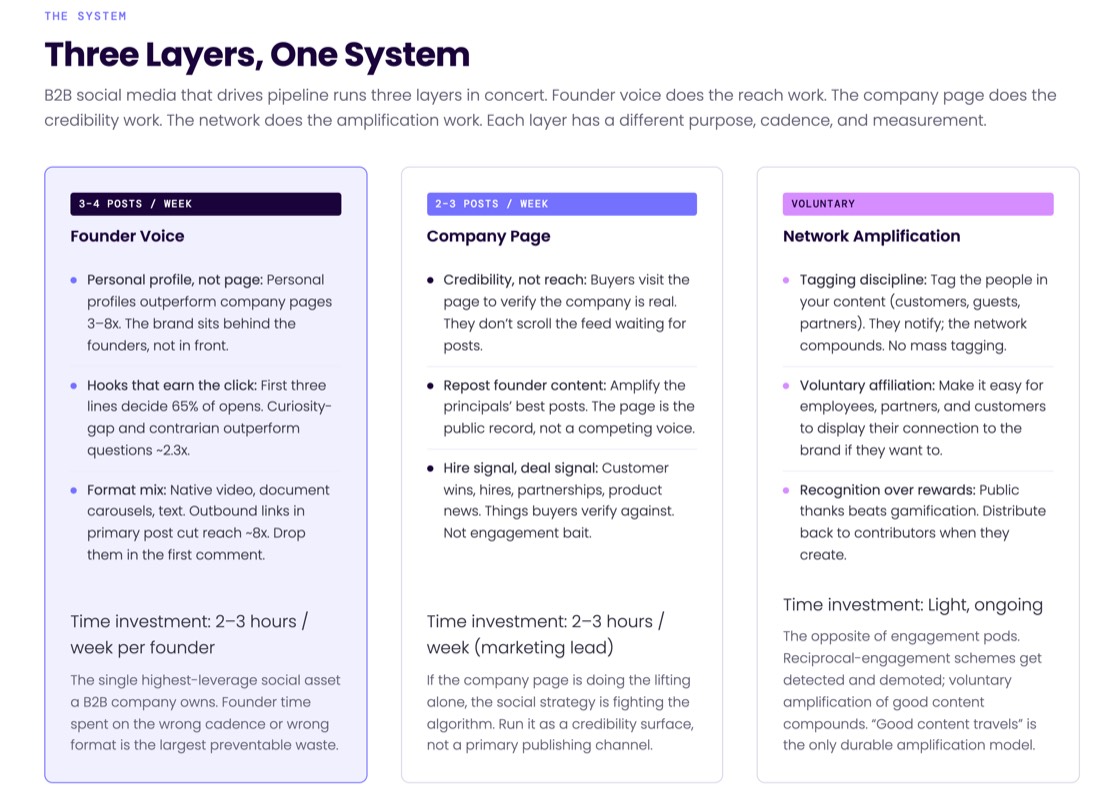
Two to four posts a week from each founder or executive principal, with hooks designed to earn the first three lines. The brand sits behind the people who run it and personal profiles do the reach work.
Lives as cornerstones, not one-offs
A bi-weekly LinkedIn Live with a practitioner or guest is the single highest-leverage production day in B2B social. LinkedIn Live earns ~24x the engagement of a standard post, and one Live becomes the source for multiple assets.
Network amplification done right
Tagging discipline, voluntary affiliation, recognition over rewards. The opposite of engagement pods, which the algorithm now detects and demotes. Employees, partners, and community members who want to amplify do so because the content is worth sharing.
Pillar pages that earn AI citations
A small set of canonical pillar pages, defining the named frameworks the company stands behind, become the surfaces LLMs cite when a buyer asks an answer engine for the best vendor or the best methodology in your category. AEO is a land grab. The companies that build pillars now own the answer.
Free Playbook
The B2B Social Playbook
The complete approach to B2B social media marketing, from executive cadence and hook construction through repurposing flows, network amplification, and AEO.
 View Social Playbook
Frequently asked questions
-
For B2B technology and SaaS companies, LinkedIn is the primary channel by a wide margin. It's where decision-makers research vendors, where founder-led content compounds, and where AI answer engines pull citations from for buyer queries. YouTube is a strong secondary surface for long-form and demos, particularly when fed by repurposed LinkedIn Lives. X, Reddit, and others can matter for specific niches, but for B2B vendors at every stage, the right answer is to do LinkedIn well before doing any second channel at all.
-
Two to four posts per week from each founder or principal is the sweet spot. The data converges on this: above four to five posts per week, returns flatten. Below two, the account doesn't compound. Add one LinkedIn Live every two to three weeks as the cornerstone production day, and the company page posts at a lower cadence — two to three per week — primarily as a credibility and replay surface for founder content. Consistency beats frequency. Two strong posts per week sustained for a year beats seven per week for two months.
-
Personal profile, by a wide margin. Personal profiles outperform company pages by 3-8x on engagement, and LinkedIn's algorithm rewards individual voice over corporate broadcast. The company page still matters as a credibility surface. Buyers visit it to verify the company exists and has signal, but it's not where the reach lives. The right model is the founder or executive voice as the primary publishing engine, with the company page reposting and amplifying. Leaders who delegate the personal profile to a ghostwriter who flattens their voice give up the leverage that made the channel work in the first place.
-
No. LinkedIn's March 2025 authenticity update specifically targeted coordinated engagement, and detection has tightened since. Reported penalties for accounts flagged as part of pods include reach drops from thousands of impressions to hundreds, with one widely cited case dropping from 8,500 to 340 impressions overnight. Beyond the algorithmic risk, pods are visible to the audience. Comments that aren't responses but trades read as exactly that. The sustainable model is the opposite: tagging discipline, voluntary amplification, and content good enough that people share without being asked.
-
Focus on pipeline-connected metrics: ICP accounts engaging with founder content, inbound conversations sourced from social, pipeline created within 90 days of first social touch, and AI answer-engine citations earned by your pillar pages. Vanity metrics — impressions, followers, engagement rate — measure activity, not contribution. A defensible B2B social attribution model uses self-reported source on inbound forms ("how did you hear about us"), branded search lift over time, and qualitative buyer feedback in discovery calls. Social rarely gets last-touch credit and rarely deserves it. What it deserves is recognition as the surface that shaped the consideration set before the form was filled.
Related services
Fractional CMO
The leadership model that connects social media strategy to your broader go-to-market motion.
Demand Generation
Social is one channel in the demand gen system. See how it all connects to positioning and pipeline.
The Book
The methodology behind the playbook. Strategy to execution to revenue.
Find a practitioner who's done this before
A strong B2B social presence doesn't build itself. Browse the OM marketplace to find a fractional CMO or demand gen practitioner who can build yours.
Browse Marketplace